Showing posts with label birds. Show all posts

Friday, February 19, 2021

Some Bird Sketches from Hikes

 While deciding whether to continue the blog, I thought that I would post a few sketches from birds seen on hikes in the last couple of months.

Ring-necked duck (Dutch Gap Conservation Area)


White-throated sparrow (Echo Lake Park)

Brown creeper (Echo Lake Park)

Golden-crowned kinglet (Dutch Gap Conservation Area)

Hooded merganser (Echo Lake Park)


Thursday, February 11, 2021

Winter Hike in Powhatan State Park

 I've hiked a number of times in the last few months at Powhatan State Park, about a 40 minute drive from my home.  I hiked a 7.5 mile loop yesterday, and decided to write about it.  The loop was hiked clockwise, starting and ending at the red circle, where a picnic shelter and bathrooms are located on the drive in.


This trail - actually about 5 or 6 different trails - goes through open areas,

as well as forests.

About a half mile of my route went along the James River, where I came across these

raccoon tracks in the mud.  I saw plenty of deer tracks as well.

Moving up from the river, the trail goes through thick hardwood forest.

Fungi are hard at work breaking down dead wood and returning its elements and molecules to the ecosystem.

It's always a bit sad to see small graveyards in the forest.

I saw and heard a number of birds, including downy woodpecker, pileated woodpecker, red-bellied woodpecker, red-tailed hawk, red-shouldered hawk, white-breasted nuthatch, blue jay, Carolina chickadee, Carolina wren, and mourning dove.  The only one I managed to get a photo of was this turkey vulture.

I really like the nuthatches.  I could not get a good photo, so I did a sketch of the white-breasted nuthatch.

Moving back into forest for the last couple of miles of the hike, I crossed this stream using the logs.  The park service should put in a bridge.

This trail is named the Pine Trail.  Can you guess why?

In this stand of trees were a number of dead pine with all the bark missing.  These snags become important wildlife habitat for a variety of creatures, starting with woodpeckers excavating cavities and hunting for insects.

Trails in the state parks are very well marked.

The Cabin Trail leaves the Pine Trail and drops sharply to a forest bottom with a nice stream running through it (with a nice, fairly new bridge to cross the stream).

Upstream a bit, I found this great skunk cabbage flower blooming.  This plant is one of the earliest plants to flower in the woods.  They are always found in wet areas, and generate their own heat to bloom in mid-winter.  The grown plant is very pungent, but a number of animals, such as deer and bear, eat the shoots when they are young.  Many kinds of animals also eat the seeds.

About a mile from the end of the hike is the remains of a cabin, which gives this trail its name.

I always enjoy the trails in this park.  I was supposed to join a group for a hike but slept so poorly that I didn't get up to join them.  Instead, doing this hike solo turned out to be a good alternative.


Tuesday, November 24, 2020

The Lazarus Woodpeckers

 Did you ever see a woodpecker rise from the dead?  While hiking in Shenandoah Saturday, I was watching two downy woodpeckers across the river, and, well, I'll just describe it using my nature journal entry:


Saturday, August 29, 2020

Nature Journal - Junco

 Since posting the other day about my nature journal, I added a page for some dark-eyed junco observations that I made last summer while leading June and July Road Scholar hikes.  Juncos live year round in Shenandoah, but are only found here in the winter.  I like these cheerful little "snowbirds," and am always happy to encounter them.  Finding the nest while leading the hike was a big thrill - everyone enjoyed getting a look at a bird nest with eggs.  Here is what I wrote yesterday and today in my journal about the Shenandoah juncos.


Tuesday, February 18, 2020

Counting the Birds

Every year, the Cornell University Laboratory of Ornithology coordinates the Great Backyard Bird Count.  This year, it went from Friday the 14th through Monday the 17th.  You can record birds as little or as much as you wish, and in your backyard or anywhere else.  I did backyard counts, as well as counts in five other areas.  Although these all involved some hiking, I really only kept track of the mileage for my hiking records on the last hike, which was Monday at Dutch Gap Conservation Area.  I hiked 6.2 miles there, and I probably hiked close to another six miles or so at the other four sites.

I saw and/or heard 51 separate species, including this beautiful pileated woodpecker.  You can scroll down past the species list to see some more photos.  Count data is entered in eBird.

The six areas, and the species counts are:

Around home - 18 species
Ginter Botanical Gardens - 11 species
Three Lakes Park - 14 species
Gaines Mills Battlefield - 15 species
Malvern Hill Battlefield (Crewes Channel) - 27 species
Dutch Gap Conservation Area - 41 species

Here is a list of the 51 species of birds I saw and/or heard during the four days of the count:

Double-crested cormorant
Great blue heron
Canada goose
Wood duck
Mallard
Ring-Necked duck
Northern shoveler
Gadwall
Hooded merganser
Green-winged teal
Turkey vulture
Black vulture
Cooper's hawk
Red-shouldered hawk
Bald eagle
American kestrel
Killdeer
Mourning dove
Barred owl
Belted kingfisher
Red-bellied woodpecker
Downy woodpecker
Northern flicker
Pileated woodpecker
Eastern phoebe
Blue jay
American crow
Fish crow
Tree swallow
Tufted titmouse
Carolina chickadee
Carolina wren
Golden-crowned kinglet
Ruby-crowned kinglet
Eastern bluebird
American robin
Hermit thrush
Northern mockingbird
European starling
Yellow-rumped warbler
Pine warbler
Northern cardinal
Eastern towhee
Field sparrow
White-throated sparrow
Song sparrow
Eastern meadowlark
Red-winged blackbird
Common grackle
Dark-eyed junco
American goldfinch

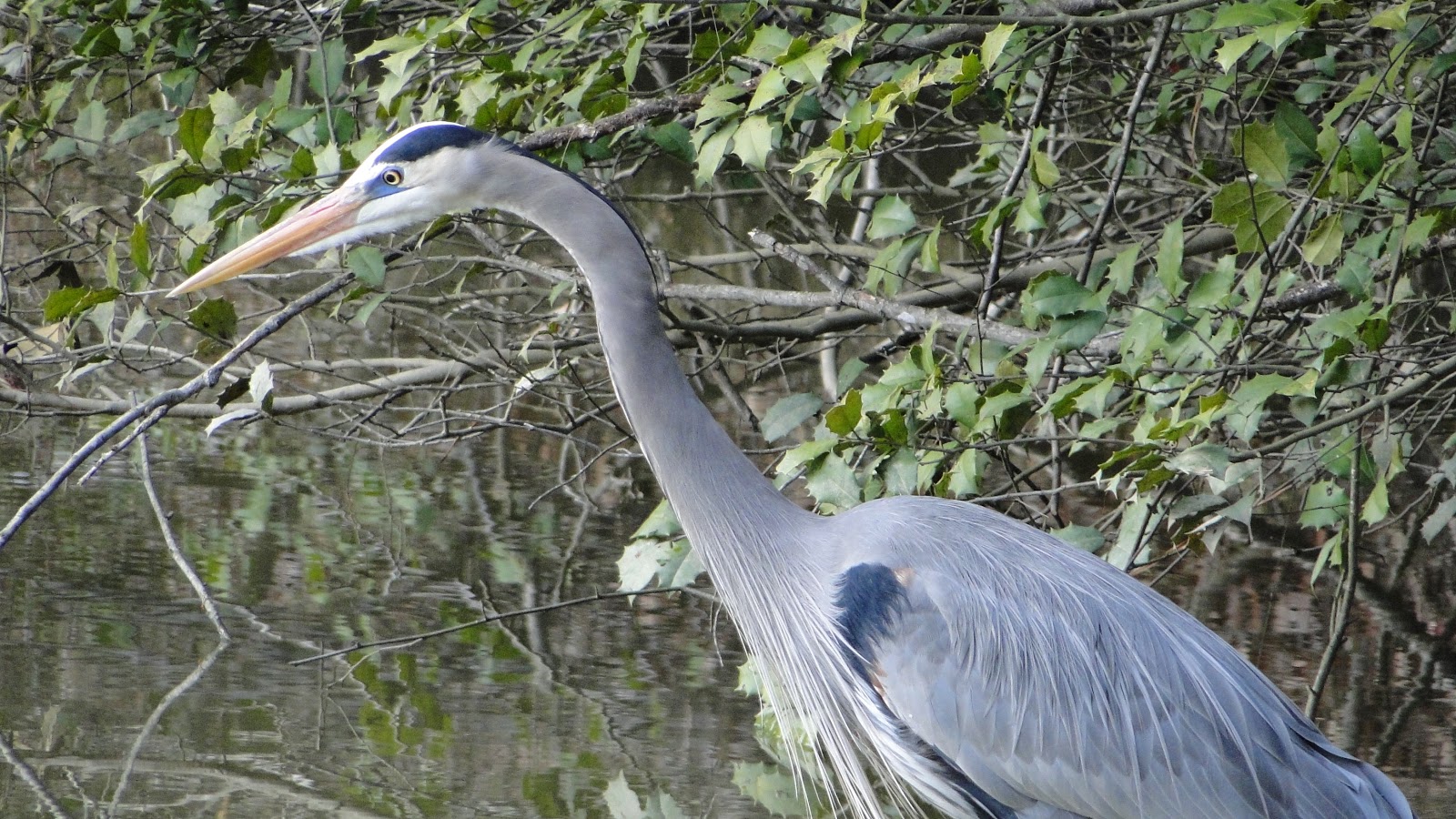
Here are some pictures of some of the birds I saw, and some of the natural features on my birding hikes, starting with this great blue heron at Three Lakes Park:


Nearby, was this group of double-crested cormorants.

At Gaines Mill, it looks like spring is in the air.
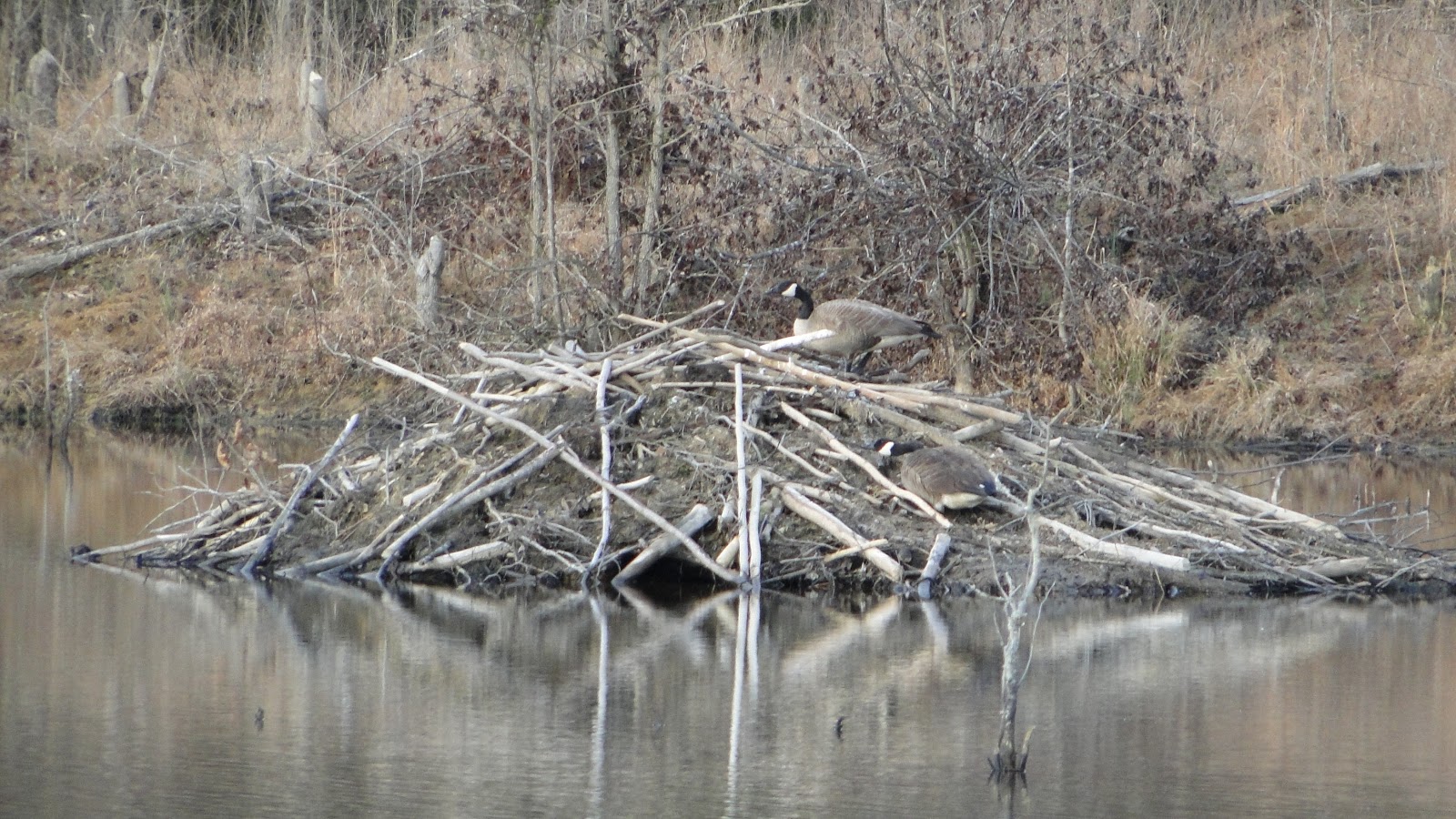
At Crewes Channel at the Malvern Hill Battlefield, while I didn't see any beaver, they were surely in evidence, and seemingly had been very busy.


The rest of these are from Dutch Gap...

Canada goose

The trees are well into bud all over, even though it's just mid-February.

Dutch Gap has a wide variety of habitats, including seasonally flooded swamps like this one.

The ducks on the left are gadwalls.  I am not sure about the one on the right.

Northern cardinal

Northern mockingbird

A pair of northern shovelers.  The drakes are so beautiful!

Ring-necked ducks - I love the yellow eye!

Birds are in terrible trouble in North America and all over the world, unfortunately.  Participating in citizen science projects such as the Great Backyard Bird Count can help scientists gain valuable information about bird populations and trends.

Tuesday, September 24, 2019

Hooooo are you?

I was in Greenville, SC on family business but took a little walk on the Swamp Rabbit Trail.  Ahead of me, a large bird flew across the trail, and landed in a tree just off the trail.  When I got close, it was still there - a beautiful barred owl.  I pulled out my mobile phone and took some photos.  He didn't call, but they have a very distinctive call - who cooks for you?  Who cooks for you-all?


Tuesday, June 5, 2018

LHHT - Birds and Wildflowers and Salamanders - Oh, My!

One of the great things about hiking the Laurel Highlands Hiking Trail in May was all of the birds and wildflowers, and also some salamanders.  When I hike, I try to observe wildlife to the extent possible.  During this hike, I noted each type of bird that I heard or saw.  Here is my list:

Oven bird, hooded warbler, common yellowthroat, black and white warbler, black-throated green warbler, black-throated blue warbler, yellow-billed cuckoo, Acadian flycatcher, eastern wood pewee, great crested flycatcher, wood thrush, veery, American robin, scarlet tanager, red-eyed vireo, tufted titmouse, black-capped chickadee, eastern towhee, ruffed grouse, common raven, red-bellied woodpecker, downy woodpecker, pileated woodpecker, whippoorwill, barred owl, turkey vulture, barn swallow, blue jay, blue-gray gnatcatcher, red-breasted nuthatch, and field sparrow.

There was a woodpecker that I couldn't identify, and one other bird that I heard but could not place, and I may have missed a few others.  Most of these were identified by their call.  I didn't have binoculars with me, and only saw a few birds that I could identify without them.

As to wildflowers, these were pretty spectacular.  Here are some photos:

Jack-in-the-pulpit

Red trillium

Yellow lady slipper - only seen once during the whole 76 miles of hiking

Pink lady slipper

Wild geranium

Violets

White trillium

Pink trillium

Yellow star grass (ID by my friend, Dick Dreselly):

May apple


As to salamanders, we saw two kinds.  The red eft, a juvenile and terrestrial stage of the eastern newt (which is aquatic as an adult), was very common, especially during the first three days of the hike, which were fairly wet.  We saw them many times.


Best as I can figure, this is a northern slimy salamander, out and about in the trail because of the wet weather on the final day of the hike.