Since posting the other day about my nature journal, I added a page for some dark-eyed junco observations that I made last summer while leading June and July Road Scholar hikes. Juncos live year round in Shenandoah, but are only found here in the winter. I like these cheerful little "snowbirds," and am always happy to encounter them. Finding the nest while leading the hike was a big thrill - everyone enjoyed getting a look at a bird nest with eggs. Here is what I wrote yesterday and today in my journal about the Shenandoah juncos.
Saturday, August 29, 2020
Wednesday, August 26, 2020
Updating my Nature Journal
Nearly four years ago, a friend of mine with Virginia Master Naturalists gave a short "class" on keeping a nature journal. The class gave us a journal with about 60 or so pages, and a set of 12 watercolor pencils. I started writing in it, and although I'd not drawn anything since elementary school art class (just after the Civil War), I tried a few sketches of birds and plants. These were mediocre at best, dreadful at worst, and I kind of put the journal aside, more or less for three years. I did, however, make written observations from time to time.
With the pandemic and my forced quarantine for health reasons, my friend said "why don't you try again?" She brought me some more stuff, and I finally got to the point in July where I wasn't feeling sick and in pain pretty much constantly, so I opened up the journal and started adding drawings. My first sketch was a blackberry plant in my backyard that the catbirds and robins loved to eat from, and it turned out pretty good (well, my opinion.) It's the first thing I tried to draw in three years, plus I did it on my birthday!
I went back to my Shenandoah experiences and did a few sketches of things I encountered while hiking. And I also added many entries and sketches of things I see in my backyard. Bottom line - in just about a month, I had filled the final 1/3 of the journal (it had taken me 3.5 years to do the first two thirds), and I've started a second nature journal, one that is not only larger with 100 pages to fill, but each page is nearly twice the size as those in my first one.
So I thought I'd share a few of the sketches I made of things I saw while hiking, mostly in Shenandoah National Park.
Here is a fungus (Heartrot fungus) that I saw on a rotten log in the park while leading Road Scholar hikes last July.
Saturday, August 22, 2020
Why the Heck am I Not Hiking????
Back in March, I mentioned that I had a coronary artery blockage and needed three stents to be placed. I was sure that I would be hiking in early May. But in mid-April, I had agonizing abdominal pain and vomiting, which I initially thought was due to giving birth to an alien! After a couple of ER visits and hospital stays a week apart, they finally figured out the problem - gallstones! Since I'd only had the stents placed a month ago, stopping the blood thinners for the removal of the gallbladder was too risky. They told me that I had to wait a minimum of five more months. So they put in a gall bladder drain - don't ask - which has been a pain to deal with but allows me to eat without getting the pain because it essentially negates having a gall bladder. Along the way, I had more problems - pain, nausea, and liver damage - that appears to be related to flushing the drain line three times a day. In late June - after losing a total of 25 pounds since March - my doctor said that I should stop flushing the drain, and the problems for the last three months have been minimal. And my liver values, while still high in a couple of cases, are moving in the right direction, and a couple of them are finally normal again. Plus, I've gained back about five pounds.
If all goes well, my surgery is about a month away. I'll be laid up for 2-4 weeks after that, and then hopefully can start getting back in shape, and maybe starting some easy hikes in mid to late October.
Fingers crossed, but boots not laced - yet!
Friday, March 27, 2020
The Beat Goes On!
On Tuesday night, two days later, I had pretty severe chest pain about 11PM and went to the emergency room. The ECG - all three of them - showed no heart attack, but they admitted me about 3AM for more testing. As things turned out, they decided they needed to look inside my coronary arteries and found that two of them were blocked! One was 100% blocked and one was 90% blocked. Three stents later, they were open and blood was flowing again. The cardiologist told me that he believed I had had a minor heart attack with no permanent damage. I spent another night in the hospital and then got sent home Thursday afternoon.
I'm not overweight, not a smoker, never do drugs, and drink very moderately. Plus, I get a lot of exercise. My diet is not perfect - butter, cheese, ice cream, and salt have been my pals. But my diet is not horrible either. In the hospital, my cholesterol was about 180. Despite all that, I had major blockages. I now have enough medications to supply a pharmacy in a third-world country. I am trying to eat very carefully. And I got permission to start walking again, starting slowly, about a week ago. I was going to participate in a cardio rehabilitation program and had my orientation earlier this week, but then they shut the program down yesterday because of the COVID-19 pandemic. I was looking forward to being monitored while exercising, so that is a bummer.
My dad needed a triple-bypass in his mid-50's so maybe I have some genetic risk factors. That seems to be the most likely thing that caused this. The cardiology nurse told me that all my walking and hiking probably delayed something that was almost inevitable, given that I do eat a certain amount of saturated fats. And my blood pressure was high, which was never a problem before, so now I am taking my BP at home a few times a day.
I won't do any serious hiking until May, when I have another cardiology appointment. But I am walking and am up to about 2 miles. My goal will be to get to three miles in a few more days and four by the end of next week.
A few weeks ago, I was planning on hiking strongly the rest of March and into April. Now, I feel grateful to be healthy and look forward to hitting the trails in about a month, assuming they don't shut the parks down. Shenandoah is still open, but camping anywhere in it is off limits, and certain really popular trails are closed, all due to the pandemic.
Happy trails, folks!
Monday, March 23, 2020
Oh, What a Beautiful Moorman (River)!
Here's a map. I started and ended at the purple circle, the Sugar Hollow Reservoir. The North Fork, which I did first) involved hiking north (pink arrows), and the South Fork involved hiking south (sky blue arrows). You can see the Appalachian Trail marked to the west. That would have been part of the longer 20 mile loop, and was the same portion of the AT that I had hiked with the group just a few days earlier.
Hiking the two trails both involved multiple river crossings. Most of these could be rock-hopped, but in a couple of spots, it looked like I would be setting myself up for a potential fall, so I waded. Here is the first crossing, on the North Fork:
The trail was very pleasant. I saw a few hikers, a few moms or couples with their kids doing a casual hike, and a number of anglers trying to catch the wily brook trout.
Here is the second river crossing, just a hundred yards or so after the first.
And here is the third crossing point, which I decided to wade for safety reasons. It was quite cold, and of course, I waded it going back as well.
My goal was to reach Big Branch Falls, which I had approached from the north a couple of years ago. There is a water slide at this point.
And there is a beautiful waterfall...
And a deep pool that would be great for a swim on a hot summer day.
Here is another view of the waterfall.
From here, I back-tracked to my car. When I had arrived, about 9:00, the parking lot was already filling up, but there was plenty of space left to park. Now, not so much. People were parking all over the place! I started hiking south. Like the earlier hike, this would involve about 2 - 2.5 miles each way and 400-500 feet of climbing, and several stream crossings, including wading one time. At the beginning, I climbed steeply for a while and had this view of the South Fork Moorman River through the forest.
Along the trail were some old homesite ruins. I always reflect on what their lives must have been like - incredibly difficult, I would imagine, but hopefully with some joy along the way.
Look at the quality of the work in this stone wall, which must have been part of a cabin or out-building at some point.
By walking steeply down from the trail, I reached this small cascade and swimming hole. Someone told me that it is called "Blue Hole." It was a pleasant day, but not pleasant enough to be tempted to take a swim.
This trail was very easy to hike.
Spring is early this year, as noted by all the wildflowers on March 8.
When I got back to my car, the parking lot - and the road coming in along the reservoir - were jammed full of cars. I could barely get my car out. On the two hour drive home, I stated making plans for my next hikes. I was thinking that in one really long day, I could complete the remaining trail miles in the Southern District of the park. But life has a way of interfering , as I learned a couple of days later. Did you ever hear the saying "If you want to make God laugh, tell Him your plans?"
More about that next time.
Friday, March 20, 2020
Last of the AT in Shenandoah
Ten of us went on the hike, and it was a merry group. We had a big enough group to allow multiple cars, and this allowed a car shuttle so we could hike one way.
A little bit of the trail went through pine forest.
Taking a short break...
I always like seeing the woodpecker holes, and I always wonder what family dramas have taken place in the nests over the years.
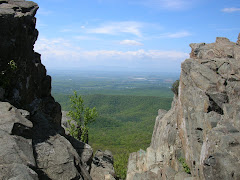
Here is one of the few views we had of the Shenandoah Valley.
Lunch break at the trail junction with the Wildcat Ridge Trail.
In early March, the park is still in late winter.
On the last couple of miles of the hike, we had a partial view of the Sugar Hollow Reservoir, which was the starting point of my next hike in a few days. I wished I'd taken a photo but there were trees blocking the way, so I kept hiking, waiting for a better view - which didn't happen.
Other than the fun of hiking with a group again - which may not happen for a while with the COVID-19 virus running all over the place - it was good to be in the mountains and actually hiking up and down, and it was good to check off these last little sections of the AT in the Park!
Monday, March 16, 2020
Back in the Mountains
I hiked two trails: the Stull Brook Trail (northern trail on the map), which was a little more than 2 miles each way, and the "backdoor" entrance to the Paine Run Trail (southern trail on the map), which was about 0.6 miles each way.
The approach to these trails is from the west, rather than from the Skyline Drive. I tried to find a third trail, but gave up after about 45 minutes of trying to get there.
There was nothing spectacular about these trails, but it felt great to be back in the mountains, even though both of these were pretty flat.
Here are some photos from the Stull Brook Trail:
The trail is a pleasant walk, kind of an old woods road going from one park boundary to another for about two miles.
Clearly, the trail maintainers have some work to do.
I like the forest in the late winter / early spring. I heard a few birds, mostly woodpeckers - pileated, red-bellied, and downy - but also a few chickadees and Carolina wrens.
The hike to Paine Run from the west is the only part of a longer trail that I hadn't hiked. Coming from the west saved me miles of hiking. I had to do several stream crossings here, which were easy enough to do with my trekking poles. I camped near this spot a number of years ago.
Not too long ago, a raccoon left proof of his existence in the mud.
This trail was a nice and easy one.
There were a lot of lovely stream views along this trail.
I enjoyed being back in the mountains, and will try to catch up my additional hikes soon.
Tuesday, February 18, 2020
Counting the Birds
I saw and/or heard 51 separate species, including this beautiful pileated woodpecker. You can scroll down past the species list to see some more photos. Count data is entered in eBird.
The six areas, and the species counts are:
Around home - 18 species
Ginter Botanical Gardens - 11 species
Three Lakes Park - 14 species
Gaines Mills Battlefield - 15 species
Malvern Hill Battlefield (Crewes Channel) - 27 species
Dutch Gap Conservation Area - 41 species
Here is a list of the 51 species of birds I saw and/or heard during the four days of the count:
Double-crested cormorant
Great blue heron
Canada goose
Wood duck
Mallard
Ring-Necked duck
Northern shoveler
Gadwall
Hooded merganser
Green-winged teal
Turkey vulture
Black vulture
Cooper's hawk
Red-shouldered hawk
Bald eagle
American kestrel
Killdeer
Mourning dove
Barred owl
Belted kingfisher
Red-bellied woodpecker
Downy woodpecker
Northern flicker
Pileated woodpecker
Eastern phoebe
Blue jay
American crow
Fish crow
Tree swallow
Tufted titmouse
Carolina chickadee
Carolina wren
Golden-crowned kinglet
Ruby-crowned kinglet
Eastern bluebird
American robin
Hermit thrush
Northern mockingbird
European starling
Yellow-rumped warbler
Pine warbler
Northern cardinal
Eastern towhee
Field sparrow
White-throated sparrow
Song sparrow
Eastern meadowlark
Red-winged blackbird
Common grackle
Dark-eyed junco
American goldfinch
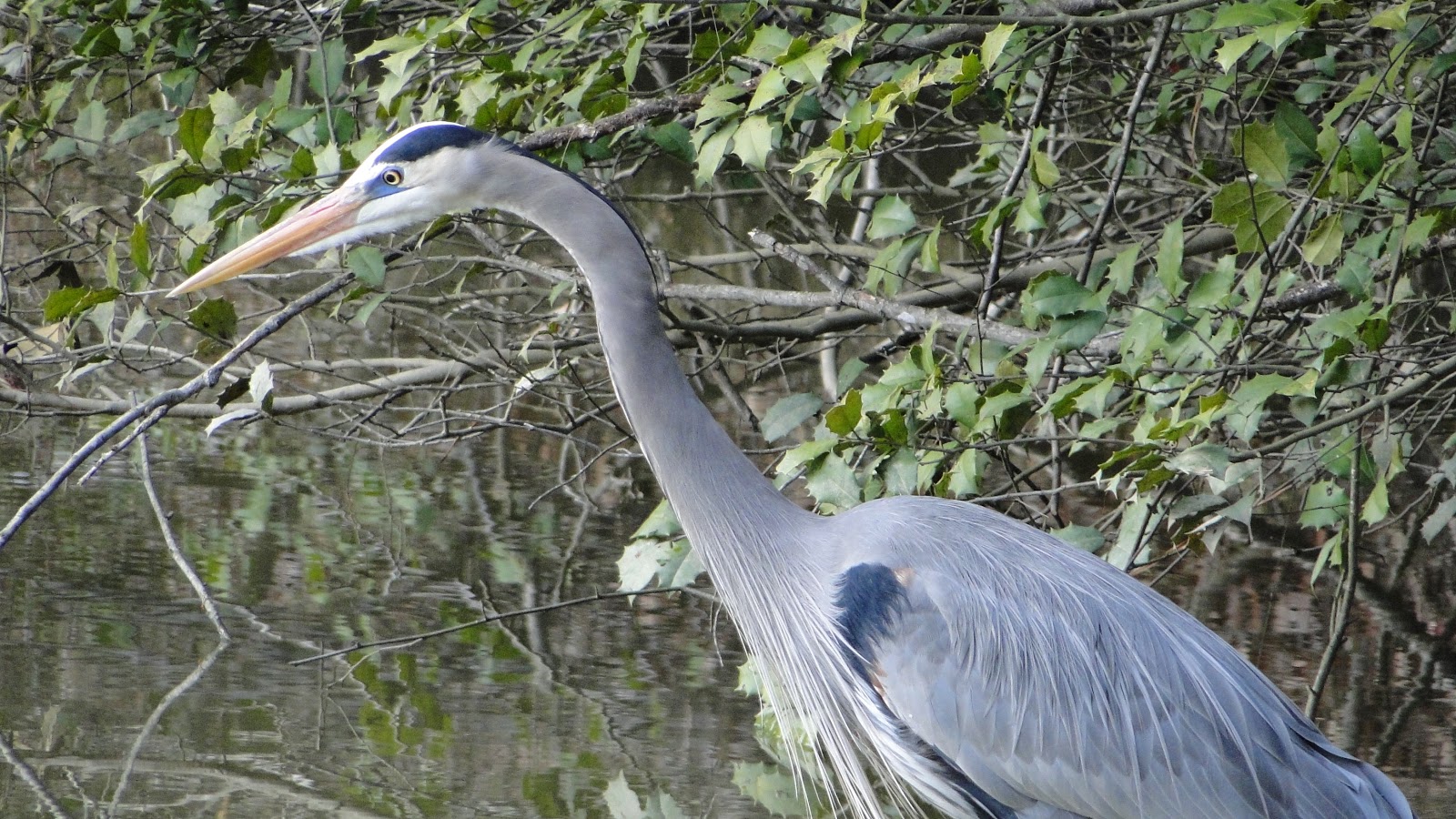
Here are some pictures of some of the birds I saw, and some of the natural features on my birding hikes, starting with this great blue heron at Three Lakes Park:
Nearby, was this group of double-crested cormorants.
At Gaines Mill, it looks like spring is in the air.
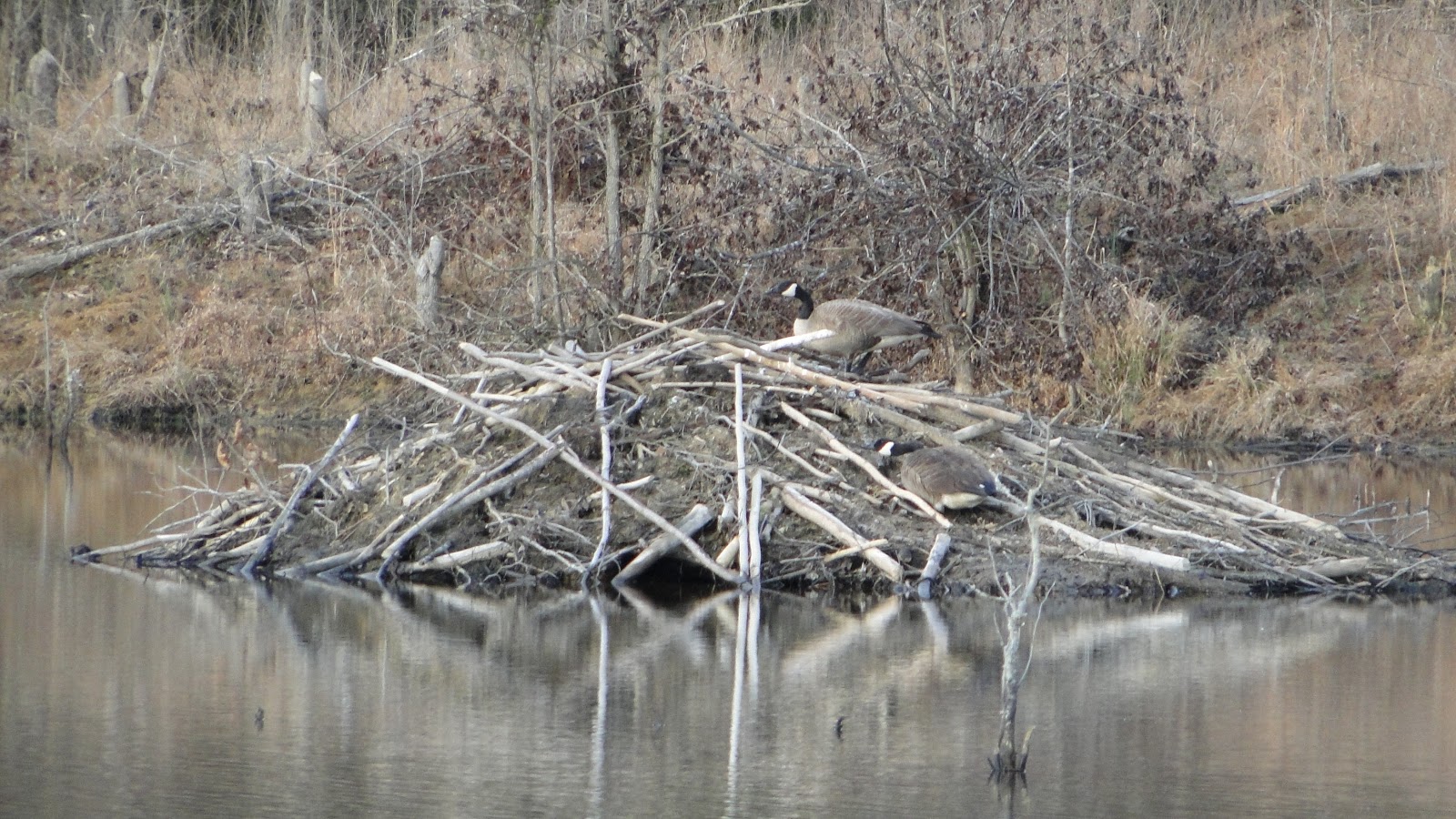
At Crewes Channel at the Malvern Hill Battlefield, while I didn't see any beaver, they were surely in evidence, and seemingly had been very busy.
The rest of these are from Dutch Gap...
Canada goose
The trees are well into bud all over, even though it's just mid-February.
Dutch Gap has a wide variety of habitats, including seasonally flooded swamps like this one.
The ducks on the left are gadwalls. I am not sure about the one on the right.
Northern cardinal
Northern mockingbird
A pair of northern shovelers. The drakes are so beautiful!
Ring-necked ducks - I love the yellow eye!
Birds are in terrible trouble in North America and all over the world, unfortunately. Participating in citizen science projects such as the Great Backyard Bird Count can help scientists gain valuable information about bird populations and trends.