I've been reading a great book by Jane Goodall, the dedicated and passionate conservationist. It is named "Hope for Animals and Their World," and was also written in part by two other authors. It is about how endangered species are being rescued from extinction, often at the last possible moment. Each species discussed is written about in the form of a separate chapter as a case study, for a total of about 40 species. Of course, this is a small subset of all possible endangered and vulnerable species of animals and plants.

I really recommend this book. It is sobering and also inspirational to think that many species still alive today are only in existance because a small number of individuals decided that something that to be done. They organized enough financial help and political will to litterally pull species away from the brink. Just a few examples in this country are the California condor, the black footed ferret, and the whooping crane. I saw the magnificent condors soaring above the Grand Canyon in 2000, and it was simply amazing - beyond words, really. They had been extinct in the wild, and now were roaming free again.
Species affected by human kind go extinct for many reasons: over hunting, habitat destruction, introduced disease and competitor species, pollution, and climate change. But animals and plants also become extinct because of human apathy. The people discussed in this book were not apathetic - they decided that a given species would not become extinct on their watch, and they did something about it. I very much recommend this book if you are interested in our natural world, and the plight of the fellow species who inhabit it with us.


 Part of the display is an American Indian village
 All of the comforts of home inside an Indian lodge
 Not only did you have to make all your own clothing, you had to kill and skin the deer, and tan its hide
 A colonial soldier on guard duty
 No electric ranges or mix-masters in those days. They were baking some kind of bread in the dutch oven, and cooking stew over the fire
 Ye olde blacksmith shop
 This home was about 50% larger than a typical colonist's home
 Turkey in a pen
 Tobacco curing in a shed. Indians' revenge? While this is the crop that made Virginia rich, today it gives us lung cancer.
 Hospital building. Anyone all upset over today's health care debate should see the wonderful medical implements of the 17th century on display here - and listen to the descriptions of the advanced medical care of those days. We have it pretty good, folks!
 The settlement is right on the James River.
 Exact replica of the Godspeed. Settlers from England traveled 144 days on this 88 foot long ship. I cannot even imagine.
 Small railing gun on the Godspeed
 Colorful Colonist
 View from today's short hike a little ways into Dutch Gap Conservation area. Go
  Presbyterian Church where "Stonewall" Jackson once worshipped, near a beautiful city park.


 The Fourth Ward had a great walking tour with many beautiful restored homes.
 All roads lead to Charlotte
 We watched little kids having a blast getting wet in this fountain
 There were many signs like this with the names of famous authors made from distances to various points - very cool!
 An imposing panther guards Bank of America Stadium, home of the Charlotte Panthers.
 Pregame festivities included a huge American flag and a flyover by four jet fighters.
 The Eagles prepare to snap the ball. The Eagles prevailed 38-10. Go "Iggles!"


 View down into Riprap Hollow's rugged terrain from an overlook on the Skyline Drive
 Junction near start (and end) of hike of Appalachian Trail and Wildcat Ridge Trail (coming in on the left). You can go either way but I started out by heading down the AT.
 White blazed mark the AT from Springer Mountain in Georgia to Mt. Katahdin in Maine.
 The wood sprite on my hiking staff takes a break while proudly displaying his Shenandoah National Park medal. My good friend Tom, who accompanied me on my Tumbledown Mountain "
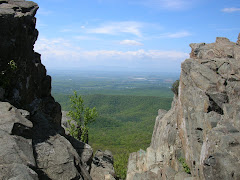
 View from Cavalry Rocks along the Riprap Hollow Trail
 View to the mountains north of the Riprap Hollow Trail
 Glad I don't have to tear logs apart for my lunch like this bear did
 The Riprap Hollow Trail bottoms out along a stream sandwiched between very steep slopes to the east and west. It is a beautiful and tranquil valley.
 I can never resist jumping into this deep pool, no matter how shocking the water initially feels on my hot skin.
 A few spots on the steep hike out up the Wildcat Ridge Trail have nice views to the south, but mostly you are in deep woods.
 Finally! A definitive answer to the question that has confounded mankind for milennia: does a wild bear leave his scat in the woods?
 A rare and welcome level spot along the Wildcat Ridge Trail