Tuesday, September 7, 2010

Flying into Kennecott

September 7. So we have arrived the Chitina airstrip, pretty much in the middle of nowhere. A tiny Cessna arrives, drops off two people, and the pilot comes over to us. We are each allowed one bag up to 30 pounds, but I cry and plead and ask if I can take my empty pack as a second bag. He is cool with it, so I dry my tears and we get on board. Mary, who is nervous about flying in a little four seater, takes the co-pilot's seat. The pilot tells her not to grab the wheel if she gets scared, because then she might get really scared by the results. Then, we are off - my first time in a little plane since 2005 when I was in Alaska for my first marathon, and took a day to fly into a remote camp for Alaskan brown bear watching - very cool!

The trip to McCarthy is about 60 miles. We could have driven, but it would have been three hours over a very rough road that has a reputation for having a special talent for blowing out tires. Plus the fine print in our car rental contract said that if we even thought about driving on a gravel road, the contract would be null and void, our home would be burned to the ground, and we would be locked in a dungeon where unspeakable things would be done to us. I might be exaggerating a little bit, but they made it quite clear that we were not to take their car off highway.

We flew over incredibly rugged country - rivers, canyons, mountains, and glaciers. Like the rest of Alaska, it is all so vast, but even more so when seeing it from the air. I will let some photos do most of the rest of the talking.

The Copper River, that of the famous salmon that are caught off shore of it.
The mountains were everywhere, and so rugged. Can you imagine being lost in such a vast and remote place?

Streams ran through deep gorges as we flew overhead. In the back, you can see the glacier that the stream comes from:
Two glaciers come together:
And two streams run through two canyons and join together:
Here is a close up view of a glaciers flowing around a huge rock outcrop:
The historic mill town of Kennicott (or Kennecott) is our destination. It is a fascinating place. The huge many-story building near center was the copper mill, to the lower left with the smokestacks is the power plant. All of this was built in the wilderness to mine and process the incredibly rich copper deposits:
Here is another view of part of the mill town, plus part of Kennicott Glacier Lodge on the right-hand edge of the photo, where we would be staying for three nights. What looks like a gray slag heap is actually all-natural glacier.
The glacier grinds rock as it flows along, and in this case, it has covered itself with a thin layer of crushed rock - less than an inch thick. Under that is all ice. You can also see some big potholes that have melted in the glacier:
Views of the airstrip in McCarthy:

Next stop - Kennicott Glacier Lodge about five miles away - we are just in time for dinner!

Heading to Wrangell - St. Elias

September 7. The weather this day was a driving and steady rain, as we left Fairbanks to head to Kennicott in Wrangell - St. Elias National Park, the largest national park in the United States. As the day progressed, the rain slackened and then we had dry periods interspersed with more rain. During times when the rain lifted, the scenery was often spectacular as we crossed the Alaska Range through a pass. We drove much of the day, because we had a plane to catch that would take us to McCarthy, population about 60. From there, it would be a five mile drive to Kennicott Glacier Lodge, where we had reservations for three nights. Along the way, we kept crossing the Alaska Pipeline, which we had seen so much of the day before on the trip to the Arctic Circle.
-
We spent a little time in Delta Junction at the visitor center. This town is the northern terminus of the Al-Can highway, constructed in about a year in 1942, an amazingly short time to build a 1,422 mile long road. It is too bad we can't respond as urgently to peacetime problems as we can in times of war. Delta Junction is where I was attacked by the giant mosquitoes. It is where I should have gassed up the rental car but did not. It turned out to be over 100 miles to the next functioning gas station, and if that one had been closed, the next one would have been about 65 more miles in Glenallen. I am not sure the car would have made it to that one.
-
We saw our last Alaskan moose south of Delta Junction. I felt bad about spooking her when I got out and crossed the road to take her picture. But a minute later, a car full of hunters came down the road, so this cow probably would not have wanted to be visible at that point.
It was raining or there was no place to stop for a lot of the spectacular scenery along the way, but now and then, we managed to get a shot.
Evenually, we reached the visitor center at Wrangell - St. Elias National Park, and had an hour or so to spare and see the exhibits. Mount Drum, a stratovolcano in the park, was beautiful and could be seen from just outside the visitor center. It rises to a height of just over 12,000 feet.
We left the visitor center, and headed for the airstrip near Chitina, which was about an another hour or so away. Along the way, we often had more nice views into the park, which is larger than New Hampshire and Vermont combined.
When we got to the airstrip with about 30 minutes to spare, it was deserted. We wondered if Wrangell Mountain Air had forgotten about us, but we found a pay phone and called their toll free number. As it turned out, the pilot was on his way with three returning passengers, and would be there on time. This winds had been gusting all day, and we wondered how the 65 mile flight into McCarthy would be. I am not afraid of flying but Mary is, and I could see that she was increasingly nervous about the whole thing.

Monday, September 6, 2010

Crossing the Arctic Circle

September 6. We'd spent one last day on September 5 seeing a bit more of Denali, including touring the sled dog kennels at Denali National Park, the only national park with working dog teams. They patrol in the backcountry all winter. Some day, this little guy will be mushing through the snow.

We drove up to Fairbanks, and relaxed for the evening. It was rainy, but we walked around a bit to see some of the city. Because of the rain, I left the camera at the hotel. On Labor Day, we left at 6:30 in the morning for a 16 hour trip to the Arctic Circle and back with the Northern Alaska Tour Company. It was a very interesting day. We went up the Dalton Highway, crossed the Yukon River, and had cake at the Arctic Circle, the imaginary line on our world that marks the southern-most point where the sun does not set on the Summer Solstice. We also had many impressive views of the 800 mile long Alaska Pipeline, a true engineering wonder. The challenges they had to overcome to build this back in the 1970's were truly mind-boggling.


-
On our trip north, we made a number of stops along the way, including lunch and dinner along the Yukon River, a learning experience about permafrost, and a short hike in a rocky area. The terrain was so vast, and varied between large stands of hardwoods in peak fall foliage, taiga, and tundra. We saw a half dozen moose on the drive but no other wildlife. Caibou and moose hunting season were in full swing, so I would guess that animals were cautious. Here are some pictures from the trip.


-
Joy, Alaska was very remote but still hours from the Circle. The population of Joy is about 12. This was the general store where we had a chance to use a very aromatic outhouse and talk to the proprietors. They also had great muffins for sale.


Clowning around on the Alaska Pipeline. About half of it is buried but any part that goes through unstable permafrost has to be elevated.

The Dalton Highway and the Alaska Pipeline cross the Yukon River. I think the pipeline crosses something like three major rivers, three mountain ranges, and 800 streams.

Panoramic view from a rocky hill we hiked around, and a view of one area from the hill.

The fall foliage was not limited to the trees.

It would be amazing to be here on the day of the Summer Solstice: 66 degrees 33 minutes north latitude. This company does a special tour here that day, leaving later in the day, and having a toast with Champaign at 2AM on top of a hill above the Arctic Circle. I would hate to be the driver for the 5 hour drive back to Fairbanks, though.

Panorama at the Arctic Circle

Saturday, September 4, 2010

Denali Scenery

September 4. Although our Denali wilderness bus tour was primarily to see wildlife, which we did in abundance, there was also spectacular scenary along the way. I decided to share a bit of my photos of this amazing park in this post.
There were spectacular river valleys at seemingly every turn:
Some of the mountains were topped by snow:
Panoramic view near Polychrome Pass:
Polychrome Pass had amazing colors:
There were rugged mountains jutting above the tundra all over:
And Denaili, The High One, made an appearance about 30 miles away:
Much of the wilderness we saw was tundra. It would be amazing, but a little scary, to backpack in this park.

High Drama on High Cliffs

During our Denali Tundra Wilderness Tour, in which we saw moose, caribou, grizzly bear, Dall sheep, and gray wolves – plus arctic ground squirrel (the fast food of the tundra) and a Canada lynx at the end of the day – we were very fortunate to witness a life and death drama on a high cliff.

As the tour bus drove along, having just spotted our first Dall sheep, people on the right hand side of the bus began shouting for the driver to stop. There, at least a mile away and at least a couple of thousand feet above us, an incredible sight was to be seen.

Two white specks – Dall sheep – were moving across a sheer cliff at amazing speed. But what was causing them to move so quickly in such a dangerous area? Hot in pursuit was some kind of animal, but what? The bus was a-buzz with excited chatter, conversation, and speculation. “It’s a wolf!” “No, it’s a grizzly!” Every pair of eyes, and every pair of field glasses, on the bus strained to see what was going on. Ultimately, we realized it was three wolves – one black and two gray colored – that had caused the sheep to run. The really incredible thing was that two of the wolves had run after the sheep quite far out on the sheer ledges. To fall would mean certain death either from the fall itself or through injury and slow starvation. But it was worth the gamble to the wolves, and to the sheep. For the latter, to not risk death from falling would have meant certain death from being eaten.

My guess is that the wolves’ strategy was to force the sheep into a panicky mistake and a fatal fall. This did not happen. You or I would have fallen attempting to cross the cliffs at any speed, but the sheep, through many thousands of years of evolution, kept their footing and their lives, at least for one more day. The wolves slowly gave up, and when we returned a couple of hours later, the two sheep were still in the same place. It was a waiting game, and the wolves were no where to be seen. The sheep were not taking any chances with such a formidable and daring predator in the vicinity, and could afford to wait a bit longer.

We were fortunate to see such a drama. I have since talked to people that had wolves come out by the road and lie by their bus, literally feet away. I would not have traded our mile-away view of wolves in action for such a close up.

I took these mile-away photos from the opposite side of the bus, trying to shoot through an open window – most of which were packed with the heads of people on the right hand side of the bus trying to get a better view. I have circled the wolves in pink and red, and the sheep in aqua and blue. In this first photo, the black wolf (lower left) is hanging behind on a steep slide area. His two pals, maybe more experienced or just more daring, have run out past the sheep and gotten above and below him towards the right of the photo. The sheep is not moving. It has reached a spot that the wolves cannot climb to without risking a fall. The other sheep was able to climb high above the action and is looking down on things.
In this second photo, the upper sheep is out of the frame. The black wolf remains in the slide, and the two lighter colored wolves have spent a lot of time exploring how to reach the sheep. But the sheep knows he is safe as long as he does not move from his ledge. It must be unnerving to have two wolves literally feet away, but sheep must have nerves of steel to live and survive where they do. The wolves look like they have given up, and are both below the sheep and are returning to their dark buddy.

Spying the "Big Five"

September 4. In Denali wildlife tourism terms, the "Big Five" does not refer to Philadelphia's great group of college basketball teams that I love to watch, but to five species of megafauna that every tourist hopes to see: moose, grizzly bear, caribou, Dall sheep, and gray wolf. Almost every tour will see some of these five species. On our tour, about 8 hours long and 60 miles into Denali National Park along the only road in the park, we were fortunate enough to see all five.

Our tour bus driver was Bill, and he was excellent. He kept the bus going around some hair-raising curves, relied on us to spot wildlife and yell "Stop!" if we saw - or thought we saw - something, and gave great commentary and information during the entire day. The tour was the Denali Tundra Wilderness tour, was well worth the money, and ended up being my favorite experience of the entire trip, edging out the Kenai Fjords wildlife cruise.

We decided to sit on the left hand side of the bus. It was a coin flip which side would have better wildlife viewing, and we chose well! Minutes into the park, we spotted a cow moose. It was on the right hand side, and far enough away that I could not get a good picture, but we had seen the group of moose last night, so that was okay. We crossed the Savage River 15 miles in, and then the wildlife spotting began in earnist.

The second of the "Big Five" was a group of three bull caribou in a magnificent setting. They were on our side of the bus, and we watched them for a long time as they ate and polished their antlers on small trees. Our new Nike camera with a good zoom lens was really proving its value:


As we drove past mountainous areas, we kept our eyes peeled for Dall sheep, which are white like mountain goats, but are a species of bighorn sheep. Suddenly, I and another guy on my side of the bus both thought we saw specks of white and the driver backed up. There, nestled in a steep mountain pass, were three Dall sheep. Do you see them? Let me zoom in a bit. There!

We watched the sheep for a long time, then continued our drive. People on the right hand side started shouting "Stop! Stop! Stop!" In the distance, flecks of white moved rapidly along a sheer cliff. It turned out to be two Dall sheep being pursued by at least three wolves, and was dramatic enough that I will post separately about this later. But now, we had seen four of the "Big Five!"

In a picturesque valley where Adolph Murie, the great wildlife biologist, lived in this cabin while he studied Dall sheep, wolves, and other wildlife, we spotted the last of the "Big Five:" this mother grizzly and her two yearling cubs:
Everyone was thrilled, and we watched them for a long time as they ambled along, looking for last meals before their long winter sleep. We continued along, spotting this group of bachelor Dall sheep near the top of a hill. If I had been on foot, I bet I could have gotten pretty close. The wildlife in the park is not hunted, and is fairly tolerant of humans.
We rode through the spectacular Polychrome Cliffs area, reached an amazing viewpoint of Denali, and turned around. On the way back, we got a great view of this lone male grizzly fairly close to the bus. He could not have cared less about us.

It was sobering to think that if you backpacked here, you would be right out among all of these animals. Despite a lot of wildlife and many hikers and backpackers, no one has been killed by a grizz in this park, though.

What an amazing day seeing wildlife and scenary (which I will post separately about)! As a bonus, late in the day, we went back into the park in our car, trying to see wildlife along the road. We saw numerous moose - none close enough for great photos, but we could see them well with binoculars. On the way out, in a light rain and just outside the park, a Canada lynx ran right across the road in front of the car! We only got to see him for about two seconds before he vanished, but it was one more incredible memory of this day, one in which we saw all of the "Big Five!"

Friday, September 3, 2010

Yes Virginia, There are Moose in Alaska

September 3. We left the Savage River, disappointed that we had not yet seen a moose or a large terrestrial mammal of any kind in Denali, or even in Alaska. As we returned along the park road towards the entrance, we kept our eyes peeled for animals as we enjoyed the magnificent scenery and colors.
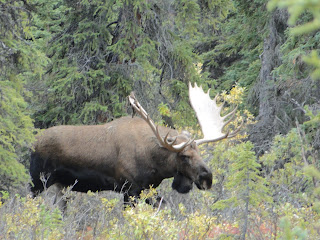
We re-entered the five mile moose rutting zone. Still no moose. Suddenly, up ahead, we noticed several cars pulled over, and a guy out with a large camera. I stopped and walked back, asking him "Do you see anything?" He pointed into the woods and said "There's a large bull moose and a cow in there." I "glassed" the woods and eventually spotted the tines of huge antlers sticking above the vegetation. As we watched, the head of a huge bull moose came into view a couple of hundred feet away.

Evenually he stepped out for all to admire before fading back into the woods. With him were two cows, a calf, and an equally large bull with a huge rack. We watched the five of them for a good 40 minutes before moving on. We never would have seen any of these animals had not someone spotted them first, but we finally had great looks at Alaskan moose.

Near the entrance to the park was a beautiful swatch of color, and even though it has nothing to do with moose, I decided to show the photos of it here: