Showing posts with label insects. Show all posts

Wednesday, August 26, 2020

Updating my Nature Journal

 Nearly four years ago, a friend of mine with Virginia Master Naturalists gave a short "class" on keeping a nature journal.  The class gave us a journal with about 60 or so pages, and a set of 12 watercolor pencils.  I started writing in it, and although I'd not drawn anything since elementary school art class (just after the Civil War), I tried a few sketches of birds and plants.  These were mediocre at best, dreadful at worst, and I kind of put the journal aside, more or less for three years.  I did, however, make written observations from time to time.

With the pandemic and my forced quarantine for health reasons, my friend said "why don't you try again?"  She brought me some more stuff, and I finally got to the point in July where I wasn't feeling sick and in pain pretty much constantly, so I opened up the journal and started adding drawings.  My first sketch was a blackberry plant in my backyard that the catbirds and robins loved to eat from, and it turned out pretty good (well, my opinion.)  It's the first thing I tried to draw in three years, plus I did it on my birthday!


I went back to my Shenandoah experiences and did a few sketches of things I encountered while hiking.  And I also added many entries and sketches of things I see in my backyard.  Bottom line - in just about a month, I had filled the final 1/3 of the journal (it had taken me 3.5 years to do the first two thirds), and I've started a second nature journal, one that is not only larger with 100 pages to fill, but each page is nearly twice the size as those in my first one.

So I thought I'd share a few of the sketches I made of things I saw while hiking, mostly in Shenandoah National Park.

Here is a fungus (Heartrot fungus) that I saw on a rotten log in the park while leading Road Scholar hikes last July.


While leading Road Scholar hikes in July and October, I saw various insects on milkweed plants, and sketched them in late July.

I also had enjoyed finding a monarch caterpillar in October on one of the hikes, and had seen a monarch on a milkweed flower in the July hikes, so I decided to sketch the life cycle of the monarch butterfly.


During the October hikes, I was delighted to find not only some small American chestnut trees, but also some chestnuts.  This tree was once the most common tree in the southern Appalachians until the Chinese blight wiped them out.  One in three trees was once a chestnut.  I also saw a bumblebee getting a late nectar snack from a thistle.  So I added these to my nature journal.


Finally, for now from Shenandoah, a couple of springs ago, I was hiking in the park with very few signs of spring at higher elevations, but at the lower elevations, I saw a dwarf iris in bloom with a wintergreen just next to it.  So I added these to the journal where I had written about that hike.

Several years ago, I took my granddaughter backpacking in Michigan.  I'd made a few sketches of the forest and lake in the field, but decided to add this sketch last month of some painted turtles on a log near our campsite.


Wednesday, August 21, 2019

Scholars on the Road

While I mull over what I will do with this blog, I think that I will write a post about a fairly unique set of hikes.  This opportunity kind of fell into my lap, but the bottom line is that I was asked to lead hikes in Shenandoah National Park for about a week in June and July for the Road Scholar program.  I really enjoyed this.  My general duties were to (1) lead a hike each day of a distance from 4.5 to 9.5 miles (2) make sure that my participants - up to a dozen at a time - were safe, stayed together, and didn't get lost (3) answer as many questions as I could - birds, wildlife, history, flowers, general plants, geology (4) interact with the hikers and keep them engaged and involved and included (5) give a talk one night to the participants (my talk was on common wildlife - mammals, birds, reptiles, and amphibians - of the park.)  In return, I got to go hiking every day, got a room at Big Meadows Lodge for the week, got three squares a day, and got paid some money.  Plus I got to enjoy the company of some really fun and wonderful people from all over the place!

The hikes were led by two of us.  Each day, one of us lead a shorter hike and one of us led a longer hike, and we switched every day.  The hikes were in the Big Meadows area, generally along the Appalachian Trail, but we threw in a bonus hike or two along the way.  The general schedule was: Monday - Big Meadows Falls loop; Tuesday - Hike from Lewis Mountain north on the Appalachian Trail until either Bootens Gap or Milam Gap; Wednesday - hike north along the AT from either Fishers Gap (longer) or Hawksbill Gap (shorter) to Stony Man; Thursday - Camp Rapidan (a 4.5 mile out and back or an 8 mile loop).  Here is a high level view of the trails.  The arrow points to the general location of the Big Meadows Lodge:


For the two weeks, I hiked about 30 miles each four day session.  We had wonderful weather almost all of the time, even in July.  98% of the people were great and a lot of fun to be with.  I'll be going back in October for one more week.  In June, the wildflowers and birds were great, and in July, we continued with great wildflowers and also butterflies.  Here are some photos from the two weeks:

JUNE -

Bumblebee approaching flowers

Fly poison, so named because earlier settlers ground the toxic plant parts and mixed them with surag water to poison flies in their cabins.

Dark Hollow Falls

Cave family cemetery in the park

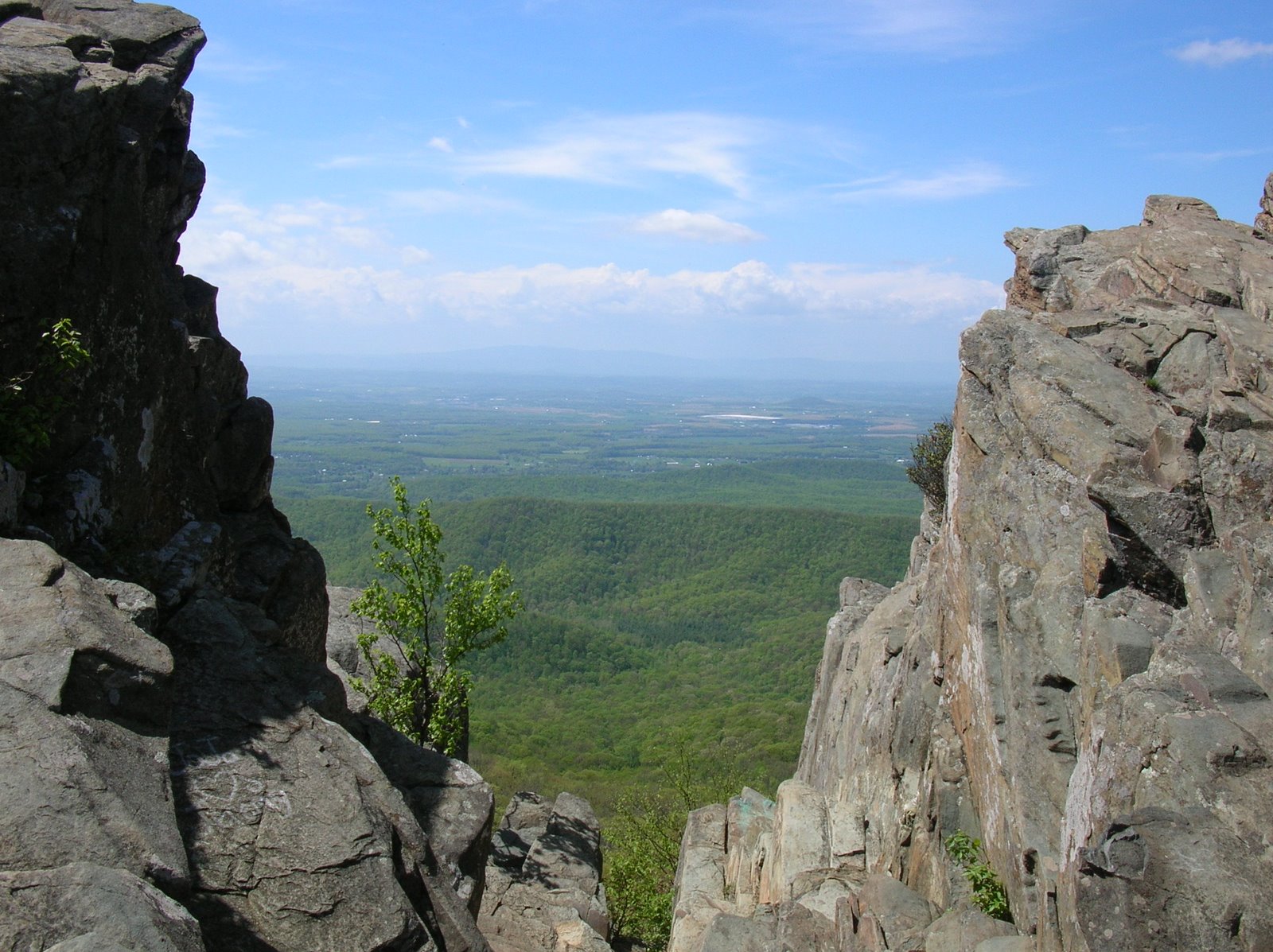
View from Bear Fence Mountain

View from Hawksbill, the highest point in the park:

Views from Stony Man, the second highest point in the park:


"The Creel," one of the cabins at President Herbert Hoover's camp:

Cottontail rabbit:

Sunset from Big Meadows Lodge:

JULY:

Dark-eyed junco nest on ground in the base of a hollow tree:

Monarch:

Question mark:

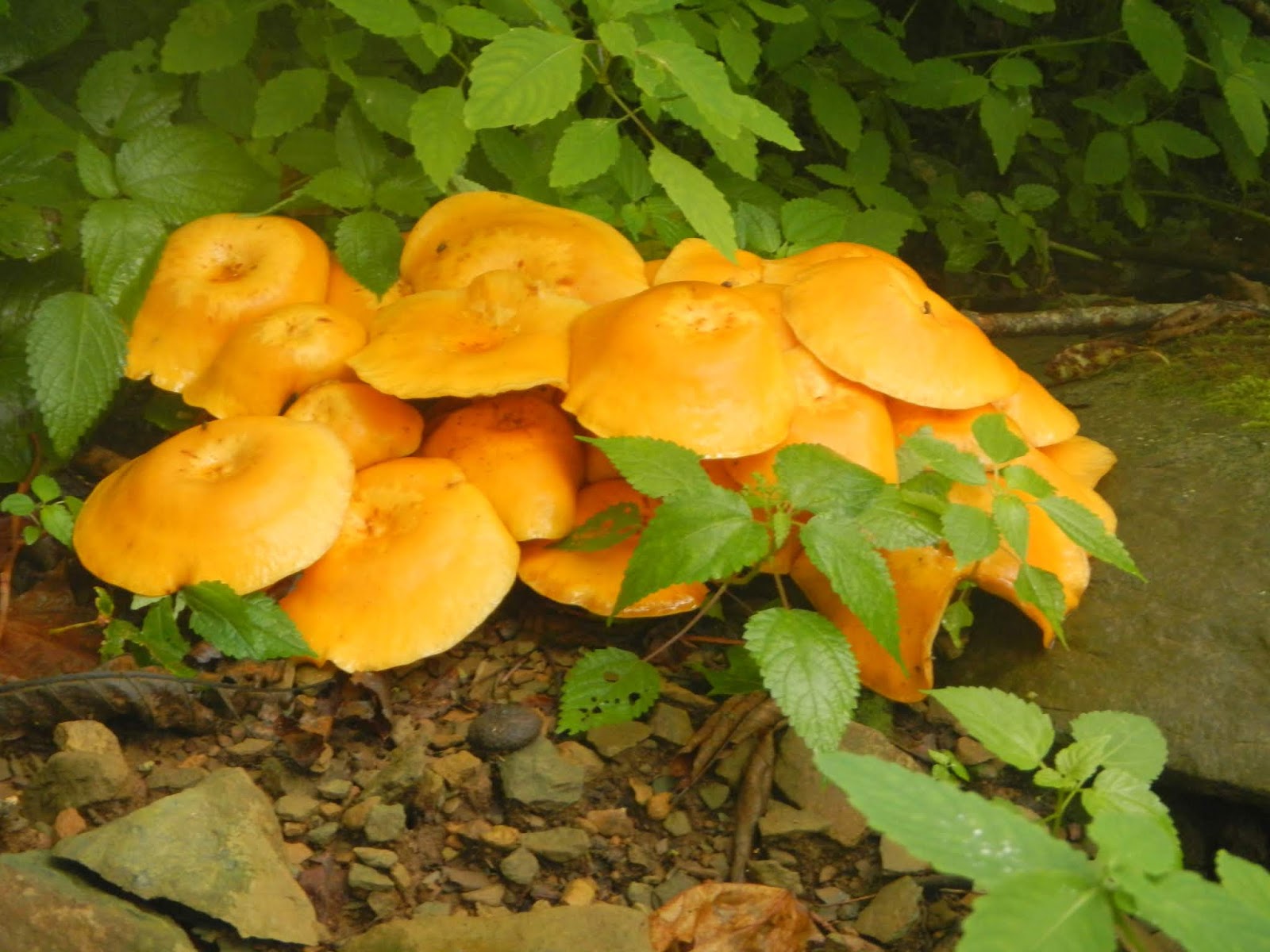
Unidentified mushrooms

Syrphid fly on flower:

Eastern tiger swallowtail:

Silver-spotted skipper:

Dark form female, and male, eastern tiger swallowtails:

Orange fungus on dead log:

Indian Peace Pipe:

Turk's cap lilies:

Beetles on milkweed:

Turk's cap lily:

Yellow and green:

White-tailed deer:

Yours truly on Little Stony Man cliffs:

The sun sets on the week:

Polyphemus Moth:

I enjoyed my two weeks helping to lead hikes for the Road Scholar program.  It was great fun with wonderful folks on beautiful hikes.  I look forward to going back in early October.

Wednesday, September 17, 2014

Return to Dutch Gap

Friday, September 12.  So, I had today off and resolved to do some hiking.  All week, I thought of returning to the mountains.  But then today came, and I looked at other things I needed to do with a busy weekend at Cape May, NJ coming up, and decided to hike in Dutch Gap Conservation Area.  It would save me at least 2.5 to 3 hours of driving, round trip.  Decisions, decisions!

I am not going to show the route of my 5.6 miles hike.  You can see a similar track here from a prior hike a couple of years ago.  And there is no need to show an elevation profile - being around an oxbow in a large river, the James, the terrain is pretty flat.  My main goals were to enjoy some time outside and see some wildlife.  I was not disappointed in either regard, enjoying a nice walk and seeing a deer, osprey, a box turtle, egrets, a green heron, various ducks, a great blue heron, an unidentified snake, and other miscellaneous birds.  Here are a few photos.

I am not sure what this small snake is.  I found it under a log, and it was very docile.

Much of the hike was within sight or a short distance from water.  This is part of the oxbow.

The walking pathways are easy and pleasant.  What a nice morning walk I had!

Seeing a box turtle is always a treat.  I've seen them before here.  Hopefully, people leave them alone when they see them and don't harm or collect them.

This one stuck its head out for a look after a while.

Dragonflies are fascinating, don't you think?

I guess the river level is low, as I can't remember seeing a nice beach on prior hikes here.

This foot bridge turned what used to be a 7.2 mile out and back hike into a 4.4 mile loop.  I did some side trails, making my total distance hiked as 5.6 miles.

Was this more fun than being at work?  Uh, duh!!

Monday, May 27, 2013

Scratching a 17 Year Itch

In June of 1996, I accepted a job with a new company.  Although the job was in Richmond, the company was headquartered in Alexandria, Virginia, which is near Washington, DC.  They needed me to come up for the day before I started to fill out paperwork and get taken out to lunch, so I took a day off from my then current job to do so.  It was a nice day, so I threw some hiking basics in the car, and on the way back, I stopped at Prince William Forest Park (near Quantico, Virginia) for a hike of a few miles.

The hike itself was very nice, but what struck me was the cicadas!  As it turned out, the 17 year brood had morphed into adults and were everywhere!  The sound was deafening.  They were all over the trees, flying through the air, zipping past my head.  It was fascinating but a little creepy too, to have these large insects buzzing past.  But I made a decision that I would come back in 17 years once again.  I quickly did the math in my head, and came up with 2013.  Guess what?  It is now 2013, so yesterday, on a simply gorgeous day, I went back.

There were lots and lots of cicadas.  I could hear them everywhere as I hiked a 7.5 mile circuit, and I saw some.  The holes where they emerged from the ground were all along the trail.  But what I didn't see was them flying past, wings buzzing with tremendous sound.  So that was a little disappointing.  Maybe that would happen in June.  Here is the map of my route, hiked clockwise as shown by the arrows, and the elevation profile.  It is not a difficult hike, and is very pleasant.  I hiked mainly on the Turkey Run Ridge Trail (west side of the map) and the North Valley Trail (east side), connecting on the Mary Bird Branch and Lake Quantico Cascades Trails.


The hike is through very pleasant forestland and much of it is along two streams.  Other than cicadas and many butterflies, I didn't see much wildlife.  I heard a pileated woodpecker hammering away, and I saw a young northern fence lizard - very difficult to spot these - and a yellow billed cockoo.  I was thinking that the cockoo would make a great "what am I?" and I was maneuvering for a photo when a couple of hikers came by me and scared him away.

I am so glad that I lived these 17 years to come back here, surviving cancer along the way.  Think of it - the animals I saw yesterday were new life in 1996!  I saw their parents.  For 17 years, they lived under the ground by the billions.  Many of them died in that time.  Human babies born the same year are now going to be seniors in high school!  16 springs and summers passed by, and they stayed under ground.  And then somehow, on the 17th spring, it was time to mature, tunnel out of the earth, climb a tree, and shed their exoskeleton.  They will live a few weeks as adults, feeding hungry creatures all over the forest.  The luckiest will breed, lay their eggs, and then die.  I know that a lot of people think they are disgusting, and even had a couple of folks tell me they wouldn't mind if they all just disappeared, but I see it as a simply amazing biological phenomina, one with few equals.  My guess is that cicadas, and other insects, will still be on this earth when we humans have come to the end of our time.

I reflected yesterday that I have a decent shot, better than a coin flip, of seeing the children of these insects.  But my chances of me seeing their grandchildren is pretty remote.  I hope I can come back in 2030 and say to them, "Hey!  I knew your mom and dad!"  But life is uncertain, and I am just happy I got back their yesterday.  Here are a few photos from my hike.

Green was the dominant color yesterday.  It is my favorite color, so I was fine with that.

About as big around as a pencil eraser, these holes were everywhere I looked as I hiked along.  They are where the 17 year old cicadas tunneled out of the ground.
I liked the blue in this butterfly.
A lot of the hike was along two pleasant streams, some with small cascades.  The mountain laurel was in bloom during my hike.
There was lots of mature forest along the way.
This little northern fence lizard was just a couple of inches long, and difficult to spot.
Pyrite mining was once conducted here.  This shows a reclaimed mine site.
The stars of the show, and the reason I came here yesterday!  I saw these guys parents.  If I am very lucky, I'll still be walking this earth to see their children in 17 years.  And if I am fortunate beyond any reason, I will see their grandchildren!