Showing posts with label snakes. Show all posts

Tuesday, February 19, 2019

Great Dismal Swamp - Southern Section

Once again, I've let my hiking blog get badly out of date.  I have taken three hikes since my last post.  I am trying to decide whether to post them or not, but at the least, I will start by posting my January 23rd hike in the southern part of the Great Dismal Swamp.

Here is the track.  We drove past the headquarters, then drove along gravel roads in the wildlife refuge.  After driving to Lake Drummond (top right corner of the image) for a quick look, we returned to the trail head for the Western Ditch (purple star) and parked the car.  The hike was about 3.3 miles each way.  We could have gone further but were getting a late start and it was a long drive home, and we hiked at a slow pace looking for birds and other wildlife.  Once we reached the end of the Western Ditch, it was a hard left on the Southern Ditch.


Dead trees might seem unsightly, but they are critically important to many animals, such as woodpeckers and other cavity nesting birds.  This one has really been worked over by woodpeckers.

Who knows what lurks in the dark swamp waters?

 The ditch trails are seemingly as straight as arrows.

Look at all the fresh stumps of small trees cut down by the industrious beaver!

Speaking of the world's second largest rodent, here is his dam.

And here is his lodge - you can see his stockpile of food in front of it.  A beaver has a pretty comfortable life until he cuts down all of his food supply.  Then, it is not so good.

We saw some birds, and recorded them on eBird as we went.  I saw an otter flash across the path, and we found the sad remains of this yellow-bellied slider.

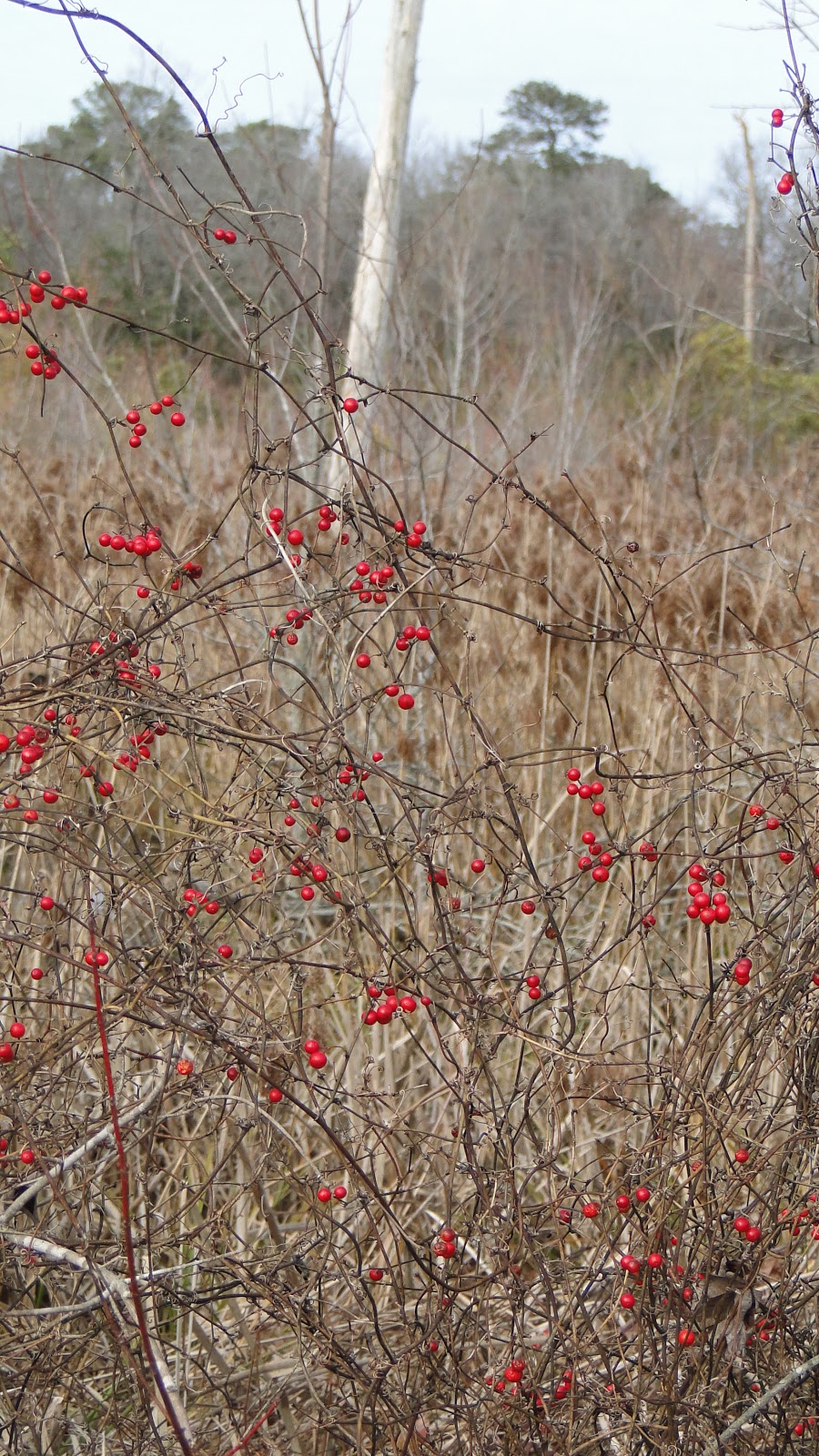
I liked the starkness of this stump and the brightness of these berries.


We were nearly back to the car when my friend Carlton said "Stop!" So, I did, thinking that he must have seen a cool bird.  I looked up.  I looked ahead.  I saw nothing.  "Look down, by your left leg," he said.  And when I did, there was this beautiful plain-bellied water snake, which until recently was named the red-bellied water snake.  I was shocked to see a snake out and about on a January day that, while not frigid, was not exactly warm either.  We got some photos for identification later, then left this little harmless snake alone.


I always enjoy exploring in the Great Dismal Swamp, and hope to return in the next month or two.

Thursday, July 13, 2017

South River Falls in SNP

This is my last week before I click over into a new year, so I wanted to be sure to do some hiking, and I also set of a goal of 120,000 steps in the last eight days of becoming even older.  So Sunday, day two of the eight days, I returned to South River Falls in Shenandoah National Park.  It is about a 5.5 mile loop, but I added a little out and backs to it for a total of 7.7 miles.  Here is the location of this hike:

And here is my track, starting and ending at the circle, falls at the red star, and lunch spot on the Skyline Drive at the red arrow.  I also did that little hike on the Appalachian Trail for a bit just to add a mile or so.

The last time I hiked here, I came upon a large black bear that initially didn't want to yield the trail, but this time, no such spectacular wildlife sightings.  I did see three snakes, and I heard a number of birds, including hooded warbler, wood thrush, eastern wood pewee, oven bird, scarlet tanager, downy woodpecker, eastern towhee, Acadian flycatcher, red-eyed vireo, Carolina wren, and Carolina chickadee.

The hike starts from a picnic area, which had these signs prominently displayed.  It warned of problem bears in the area, which certainly became problems because of careless or ignorant humans.  Once a bear begins to associate humans with food, the best outcome will be the death of the bear.  The worst will be the death of a human AND the death of the bear.  Enjoy seeing a bear but never feed them, not even a cute little cub.


The path was generally nice and wide, and well maintained.  To get lost, you would have to be totally not paying attention.


After about a mile and a half, there is a viewpoint to the falls, deep in the forest.  It is about another mile to get to the base of the falls.

On the approach to the falls, I encountered the three snakes.  This one is a northern water snake, I believe, as was one of the others along with a ring-necked snake.

The falls plunge over 80 feet and were spectacular!


I lingered for a while admiring the waterfall, then headed back on the South River Falls Fire Road, a wide and pleasant path.  It was on this path that I saw the bear last year, so I stayed alert.  I also carried bear spray just in case, but I've never needed it.

I had lunch here on the Skyline Drive, and chatted with Canadian and German travelers....


... and ended my hike by going about 15 minutes north on the storied white blazed AT, then returning on the AT to the parking area.  Along the way, I met Woodbury, a through hiker heading for Maine.  He had no beard and I asked him about that.  It turned out that he started hiking in March from Georgia and took a 1.5 month break to attend to some family stuff.  The day I met him was his first day back on the trail!  He will reach Maine in October.

Sunday, June 4, 2017

Doyle's River

One of my favorite hikes in Shenandoah National Park is the Jones Run - Doyle's River loop, a moderately rugged hike of 8.6 miles.  On Friday, I led a group of seven of us on that hike, and we had a great time on a beautiful spring day.  It was my first time up in the mountains in several months, and it felt great to be back.

By the way, it was this very hike last July where I had a little too close encounter with a black bear.  No such wildlife sightings this time around, and with a group of seven, the chances of seeing major wildlife would be unlikely.

This hike drops down through a stream valley and then climbs steadily back out.  Along the way, three great waterfalls are passed, and this time, all three of them were gushing with water and were very scenic.  Other times of year, they may be barely running.  Here is a track of the route.  The red star marks the beginning and end of the hike, and the red arrows show the direction of travel.  The black arrow shows the location of Big Falls on Jones Run, and the purple arrow shows where the Upper and Lower Doyle's River Falls are located.


When hiking with a group, I can't dilly-dally as much, and so I take less photos.  But on this hike, it is the waterfalls that are the real attraction, so my photos will concentrate on these.  In about a mile and a half, an impressive waterfall, Big Falls on Jones Run, is reached.  Here it is, along with one of my comrades, and a separate one of yours truly.


I heard a lot of birds - eastern towhee, ovenbird, hooded warbler, red-eyed vireo, and eastern wood pewee.  But as far as visible wildlife, this garter snake was it.

An even prettier waterfall is Lower Doyle's River Falls.  It is mesmerizing to watch it.

A short distance upstream is Upper Doyle's River Falls.  Here, some of my group begin getting ready for a lunch break.

This waterfall cascades over two levels.  Eventually, all of this water will flow into the Chesapeake Bay.


On the hike out through the green tunnel, there was also a chance to see mountain laurel in bloom.

Where would you rather be on a beautiful Friday spring day? In the office, or in the mountains, hiking and looking at waterfalls with a nice group of people?  Clear choice for me!

Saturday, March 12, 2016

Dismal, No; Fun and Interesting, Yes!

One of my hiking goals for the last couple of years is to lead some hikes, and as part of that, get more active in the local hiking group, the Old Dominion Appalachian Trail Club (ODATC).  Yesterday, my day off, I took some action towards that goal by leading a group ODATC hike on the Washington Ditch Trail in the Great Dismal Swamp.  This trail goes to Lake Drummond, one of only two natural lakes in Virginia.  This large (3,100 acres) lake was likely formed by either a meteor impact or by a long burning huge wild fire in a deep peat deposit.  Four of us hiked this together yesterday.  It was a great group of people to spend a day out together in a place that was far from dismal.


The hike was an out-and-back, with a total distance of 10.2 miles.  The pathway was level, smooth, and dry, even though there was wet swamp all around us.  Near the trailhead, there is an interesting "boardwalk" pathway that goes through the swamp, and it is well worth taking.

We saw a fair amount of wildlife: turtles (common snapping turtle, red-bellied slider, and yellow-bellied slider); black vultures; pileated woodpeckers; a large cottonmouth; double-crested cormorant; three unknown ducks; great blue heron; several groups of butterflies; and some kind of a carnivore from a distance.  We think the latter was a bobcat, as it appeared to have (through binoculars) a cat-like face, short ears, and no prominent tail, but we couldn't rule out a grey fox.  We decided bobcat, 90%.  My last hike here, three years ago, I saw this animal - but not this time.

There are many other pathways to explore in what is left of this large swamp, much of which has be drained and converted to housing developments, farms, and woodlots.  The part that remains (113,000 acres plus the lake) is a national wildlife refuge and "contains some of the most important wildlife habitat in the mid-Atlantic region."  The Washington Ditch trail is a straight shot to the lake, and is very pleasant and interesting.  Water is always to one's right walking to the lake, and quite often on the left was well.  There are large stands of cypress and other water tolerant trees the entire way.

Here are a bunch of photos from our never-dismal hike, starting with Jeff, Jo Lee, and Aseeyah at the start of the hike.


This hike has some historic significance as well as great natural history.  George Washington did the original survey work for a canal here.

This is typical of the swamplands along the pathway.

A raccoon passed this way and left its tracks.

Spring flowers, such as this violet, are beginning to bloom here.

This group of butterflies, which I believe are zebra swallowtails, were clustered on some animal scat.  There were also a few tiger swallowtails that came in to the cluster at times.

We saw many turtles, like this yellow-bellied slider, catching some rays on this day with temperatures in the mid-Seventies (F).

Along the hike, we found many pieces of wood that had been cut by beaver and stripped clean of bark, one of their major food sources.  And near Lake Drummond, we saw a beaver lodge.

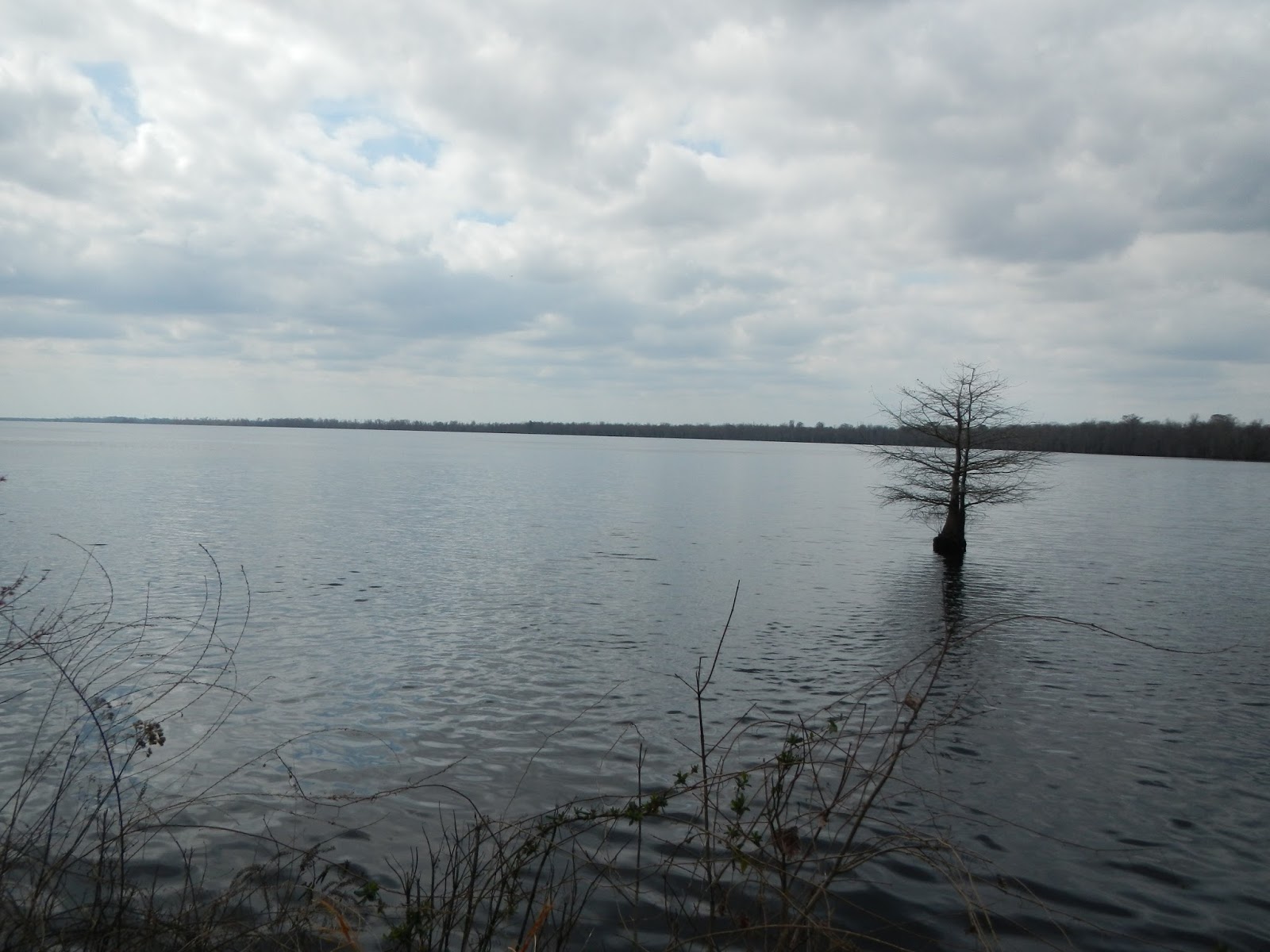
Lake Drummond, one of Virginia's two natural lakes.

The lake water looks a bit like weak tea from the tannic acid.

We saw this large water moccasin (cottonmouth) near the lake shore.  Although we were just feet away, it was not aggressive - nor were we.  With binoculars, we could see the "pit" on its snout, which makes it a member of the pit vipers.

Swamps were once considered wastelands, but we now know that they are very important ecologically. Plus, they are just plain interesting.


Cypress "knees" are part of the root system of the cypress, and are believe to help anchor the tree's shallow roots in a wet environment and perhaps aid in the oxygenation of the tree's roots.
We all agreed that this was a fun day hike, and beat working (for those who still work).  Aseeyah thought that it would be great to come back here for a night hike to explore the swamp after dark, which would be very cool with headlamps or even in a bright full moon.  And she and I thought that coming here a couple of times a month year round and taking careful note of the changes would be a great natural history study (she and I are both studying in the Virginia Naturalist program).